Cologne Robot Incident Raises a Hard Safety Question: Who Controls the Machine?
Cologne police are investigating whether a robot involved in an alleged harassment incident was remotely controlled or preprogrammed. The case exposes practical safety, consent and evidence gaps for public-facing robots.
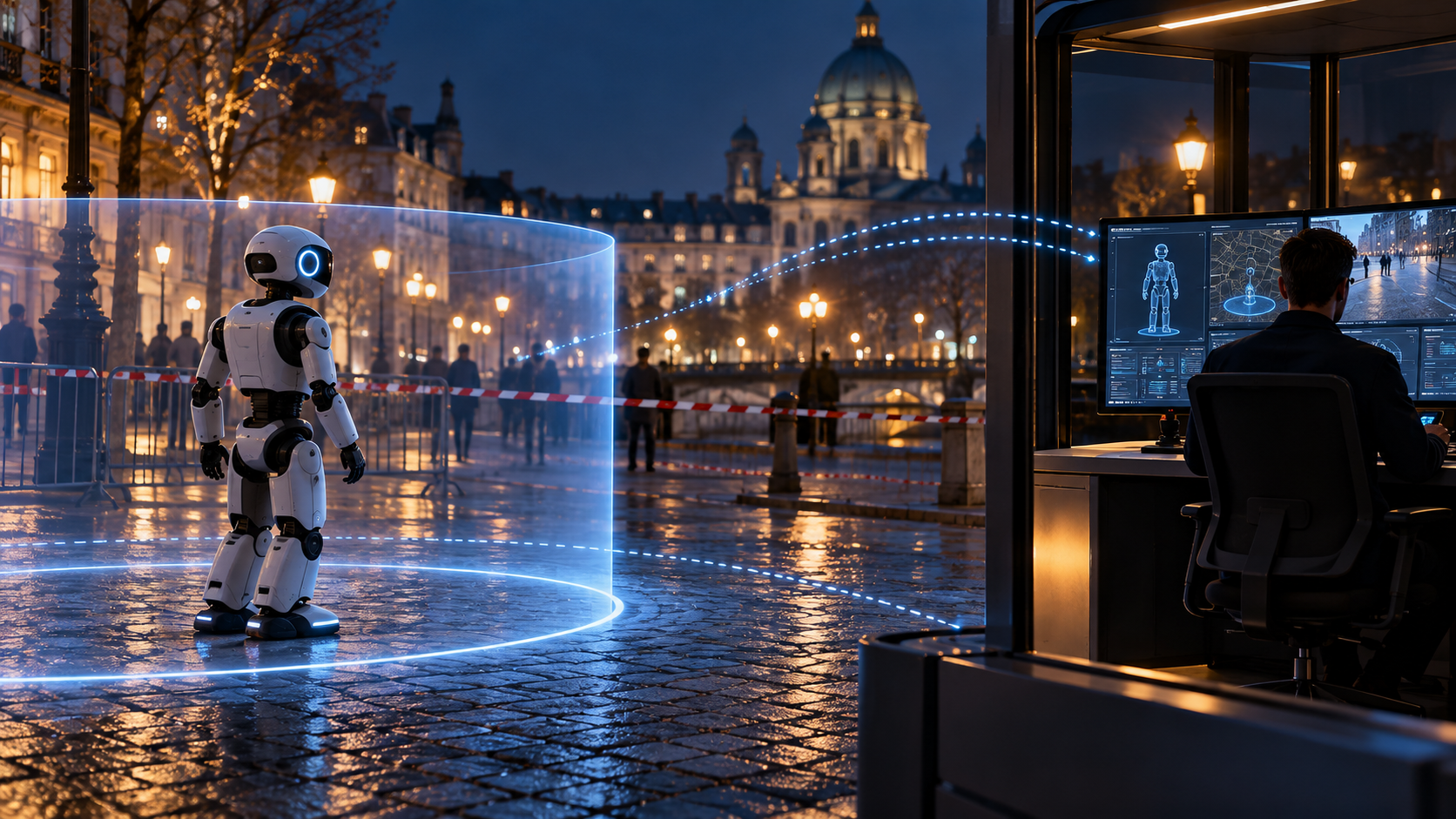
Original BizarreSexuality.com editorial illustration generated in-house on 15 October 2026. No victim, minor, real person, police insignia or branded robot is depicted.
Cologne police are investigating an alleged incident involving a robot and a 16-year-old in a public street. Their statement says the machine and two phones were seized while investigators determine how the robot worked and whether its movements were deliberately controlled. The uncertainty matters: it is not yet established whether the relevant action was directly teleoperated, triggered by a stored routine or produced through another control path.
Associated Press reporting confirms that investigators were treating two young men as suspects at the time of publication and that they had not been charged. This article uses allegation language, does not identify the minor and does not reproduce the circulating footage. The goal is to examine the safety architecture that public-facing and companion robots need regardless of the final technical finding.
The case is unusually relevant to buyers and developers because the same cameras, remote apps, learned motions and mobile bodies that make a companion robot useful can also make misuse harder to attribute. A safe product needs more than a capable model: it needs accountable control, enforced physical boundaries, visible operating modes and proportionate evidence.
What police have established — and what remains unresolved
Cologne police said a roughly 1.2-metre robot was seized after an alleged incident during the night of 11 October 2026. Their 12 October statement says investigators also seized two mobile phones and are examining how the machine operated at the relevant time. The investigation concerns suspected conduct with a sexual dimension. Because it is an active investigation, the police account uses allegation language and does not establish criminal guilt, intent or a final technical cause.
The central technical uncertainty is unusually important: investigators have not yet said whether a person issued real-time commands, whether a stored routine produced the movement, or whether another control mode was involved. Associated Press reporting likewise says the two young men identified by police had not been charged when its report was published. A responsible technology article must therefore avoid converting an unresolved control question into a confident story about autonomy.
Why control attribution matters for robotics safety
A robot can move through direct teleoperation, waypoint commands, scripted behaviours, model-driven autonomy or a mixture of those modes. From the public’s perspective, the body is the visible actor; from an engineering perspective, responsibility may pass through an operator, application, network link, behaviour library and safety controller. If a system does not record those transitions clearly, reconstructing an incident becomes unnecessarily difficult.
Attribution is not only a courtroom issue. It shapes prevention. An abusive operator requires access controls, identity, sanctions and tamper-resistant logs. An unsafe stored routine requires review, limits and safer defaults. A perception or planning failure requires better sensing, separation and testing. Teams should not choose a preferred explanation before evidence is available, because each cause demands a different corrective action.
Consent must be designed as a physical boundary
Public-facing robots should not treat silence, proximity or a camera view as consent to physical contact. A bystander may not know that the machine can approach, gesture, record or be controlled from elsewhere. The safe default is a non-contact operating envelope, low speed near people and a visible way to stop or avoid the machine. Social playfulness does not erase the need for explicit boundaries.
Designers sometimes focus on collision forces while overlooking social intent. A movement can be mechanically gentle and still violate personal boundaries. Safety reviews should therefore include prohibited approach patterns, body-zone restrictions, crowd behaviour and the effect of recording. A companion or entertainment robot needs rules for shared public space that are stricter than the behaviour permitted in a controlled demonstration with consenting participants.
Teleoperation needs accountable operator identity
A remote-control interface should bind commands to an authenticated operator and a specific device session. Shared passwords, anonymous streaming controls or unattended consoles make accountability weaker. High-risk motion functions should require stronger authentication, and systems deployed around the public should prevent a casual viewer from taking control through an exposed link. Access should expire, and revoked operators should lose control promptly.
Logs should record who had authority, which mode was active and what command path reached the robot. That does not mean collecting unlimited personal data. A privacy-preserving design can retain security events, timestamps and signed command identifiers while limiting video retention and access. The objective is a defensible chain of control, not surveillance for its own sake.
A visible mode indicator is more than a status light
People near a robot should be able to tell whether it is autonomous, remotely driven, paused or in an error state. A small icon hidden in an operator application does not help a bystander. Mode indicators need to be legible from the interaction distance, consistent across transitions and difficult for an operator to suppress. Audible cues can help, but they must not be the only channel.
Mode clarity also helps investigators and support teams. If recorded video shows a transition from autonomous navigation to direct control, the timeline becomes easier to reconstruct. The indicator should not reveal an operator’s identity or private content; it should disclose the control state that affects nearby people. Manufacturers can pair that with a public explanation of what each state means.
Geofencing and separation should constrain behaviour
A human operator should not be able to bypass every local safety rule. The robot can maintain a protective zone, cap speed in crowded areas and reject commands that would produce prohibited contact. NIST work on human-robot interaction and speed-and-separation monitoring illustrates the broader engineering principle: safe operation depends on measuring distance, motion and system capability, then enforcing constraints rather than trusting intent alone.
Consumer and entertainment robots differ from industrial arms, so a factory standard cannot simply be copied into a nightlife district. The principle still transfers. The machine needs a conservative response when sensing is uncertain, communications are delayed or people move unpredictably. A stop, retreat or low-energy posture is preferable to improvising close physical behaviour while the system lacks confidence.
Emergency stop design must serve bystanders too
An emergency stop is useful only if someone can find and activate it quickly without approaching the hazardous part of the machine. A remote kill switch helps the operator, but a local control or clearly communicated stop method may also be necessary. The robot should enter a stable state rather than fall, roll or continue a gesture after communication is lost.
Manufacturers should test stops during motion, network failure, low battery and software faults. Operators need training that treats an unexpected approach as a stop condition, not entertainment. Event staff or venue personnel should know who can isolate the machine and preserve logs. A paper instruction stored in a transport case does not protect a member of the public encountering the robot unexpectedly.
Recording and live streaming multiply the harm
The police statement says the alleged incident was filmed and streamed. Recording changes the risk profile because an event can be replayed, redistributed and detached from context. The AP reported that Cologne police later warned that jokes or sharing could worsen the effect on a victim. This is a reason not to embed or reproduce circulating clips, especially when a minor is involved.
Robot operators should separate navigation sensing from content creation. Cameras needed for obstacle avoidance do not automatically justify storing or broadcasting identifiable footage. Streaming should require a deliberate mode, visible notice and moderation rules. Platforms and operators should preserve relevant evidence when lawfully required while avoiding viral redistribution. Editorial outlets can report the safety questions without turning the alleged act into spectacle.
Evidence needs synchronized robot, app and network logs
Video alone may show movement without revealing who or what caused it. A useful event record aligns robot state, command source, active behaviour, sensor confidence, safety-controller interventions and network health on a common clock. Logs should be protected against casual editing and retained for a defined period. They should also be exportable through a documented process for authorised investigation.
Over-logging creates its own privacy and security risks, so retention must be proportionate. The system does not need a permanent archive of every conversation or face to prove that a command was sent. Manufacturers should publish what is logged, who can access it and how deletion interacts with incident preservation. Buyers evaluating a companion robot should ask these questions before bringing microphones, cameras and actuators into a home.
What buyers and venues should ask before public use
Ask whether the robot can be teleoperated, who can obtain control, how operator accounts are protected and whether commands are attributable. Request the public-space safety mode, speed limits, separation behaviour, stop procedure and response to lost connectivity. Confirm whether cameras record, whether footage leaves the device and whether live streaming is possible. A polished demonstration is not evidence that these controls exist.
Venues should require a named responsible operator, an operating boundary, a pre-event test and an incident plan. They should decide where the robot may move, when filming is allowed and how bystanders receive notice. A device marketed for companionship or entertainment still becomes mobile machinery when placed in a crowd. Insurance, local rules and safeguarding duties should be reviewed by qualified professionals rather than inferred from a product page.
What manufacturers should change now
Manufacturers do not need to wait for a final finding in this case to audit predictable misuse. They can review whether operators are strongly authenticated, whether high-risk gestures are restricted near people, whether the robot discloses its control mode and whether local safety constraints remain active under teleoperation. They can test whether logs answer the basic question of who controlled the machine without exposing unrelated private content.
They should also create an abuse-reporting route that reaches a safety team rather than a generic sales inbox. Software updates need signed delivery and a published support period. If a behaviour library can be taught or imported, unsafe motions should not bypass proximity rules. Responsible companion robotics is not achieved by a disclaimer alone; it requires product controls that assume some users will behave badly.
Reporting this case without turning uncertainty into hype
This incident should not be framed as proof that robots have developed criminal intent. Nor should it be dismissed as a prank simply because humans may have been involved. The documented facts concern an alleged act, a seized machine and phones, and an open question about control. That is enough to justify scrutiny of teleoperation, safety boundaries, logging and consent without inventing a technical conclusion.
BizarreSexuality.com will not identify the minor, embed circulating footage or repeat unverified claims about the robot’s manufacturer. The article will be updated if Cologne police publish a material technical finding. Until then, the strongest lesson is procedural: human-facing machines need accountable control, enforced separation and evidence that survives an incident. Novel hardware does not make ordinary personal boundaries optional.
Sources and methodology
- Cologne Police statement, 12 October 2026 — primary source for the seizure and open control question.
- Associated Press report, 13 October 2026 — independent reporting and police interview.
- NIST Human-Robot Interaction programme — background on trust, safety and test methods.
Related practical guides
Review the site’s camera and microphone privacy guide, companion-app security checklist and 24 return-window tests before enabling remote access or recording features.