Companion Robot Subscription Costs: Calculate the Real Five-Year Price
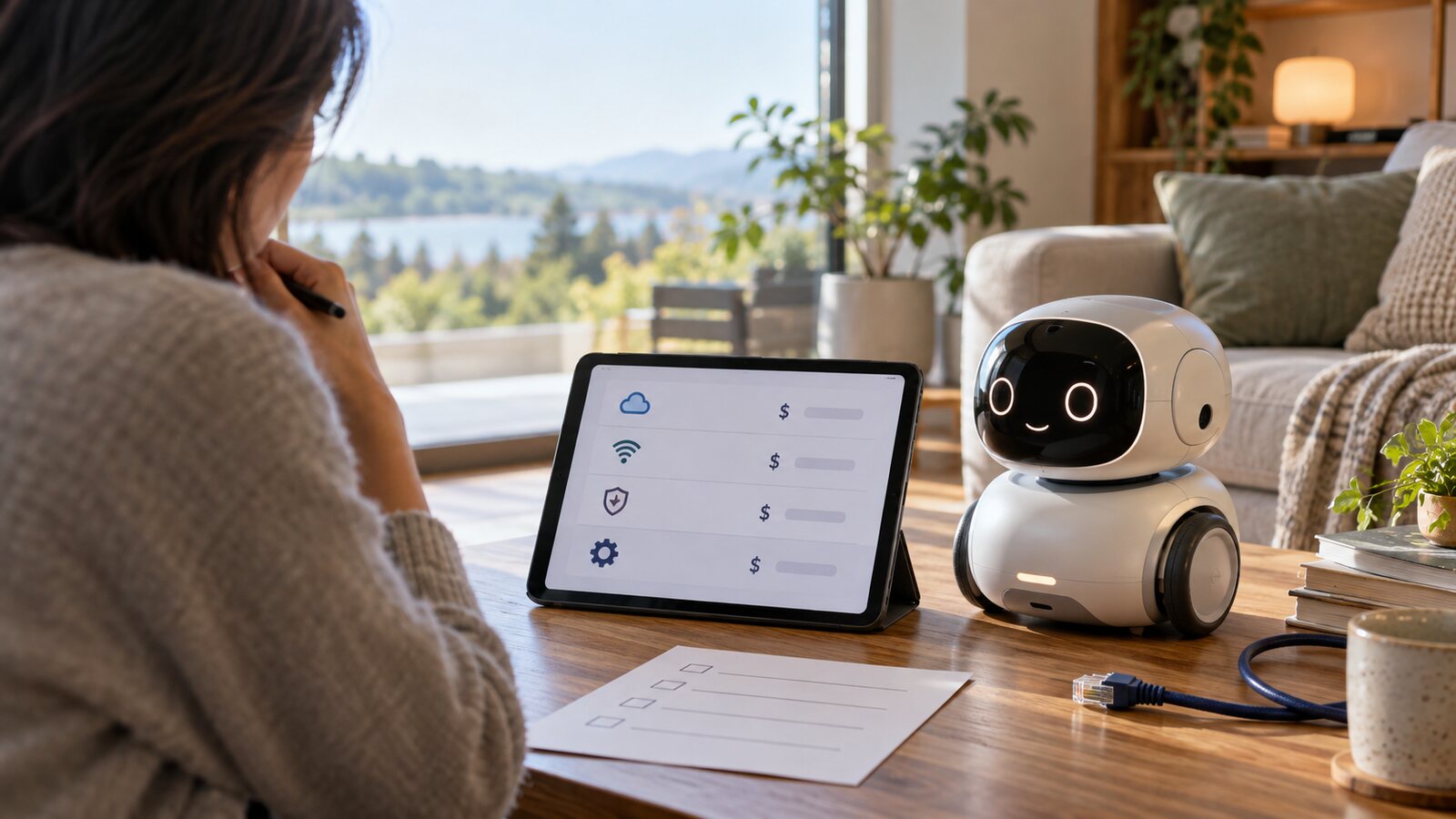
Direct answer: calculate a companion robot’s five-year price by adding the purchase price, mandatory subscriptions, realistic connectivity, accessories, expected battery or wear-part replacement, shipping, insurance and disposal costs. Then subtract only guaranteed credits or resale value. Keep optional cloud features in a separate scenario, because a low purchase price can hide a service dependency that costs more than the hardware over time.
A companion robot is rarely a single purchase in the same way as a chair or a kettle. The hardware may need an account, a mobile application, cloud processing, security updates and replacement parts to deliver the functions demonstrated at checkout. That makes the sticker price useful but incomplete. A buyer needs a repeatable cost model that distinguishes what the machine can do locally from what remains available only while a paid service and the vendor’s servers continue operating.
This guide does not rank products or predict future fees. It gives you a worksheet for asking vendors precise questions and comparing written answers. Product terms, regional taxes and warranty rights vary, so verify them before paying. The method is deliberately conservative: it does not invent resale value, assume that a promotional subscription will continue, or treat an unsupported feature as part of the product.
Start with three cost scenarios, not one attractive total
Build a minimum, expected and stress scenario. The minimum scenario contains the purchase price and only costs explicitly required for the robot to perform the functions you actually want. The expected scenario adds likely consumables, one realistic repair allowance and the subscription tier you would choose after the trial ends. The stress scenario asks what happens if a battery, drive module or display fails outside warranty, shipping is charged both ways, or a premium cloud feature becomes essential to your routine.
Do not average these three totals into a number that looks precise. Their purpose is to expose dependence. If the minimum and stress scenarios are close, the ownership risk is relatively visible. If they differ by thousands, identify which assumptions create the gap. A salesperson’s monthly figure should be converted into the same five-year period as the hardware. Multiply monthly fees by sixty and annual fees by five, then add any activation or cancellation charge documented in the terms.
Separate the robot’s purchase price from the usable system price
The advertised hardware price may exclude tax, freight, customs charges, setup, a charging dock, a compatible phone or a required controller. List each component needed on day one. If a vendor offers several bodies, heads, mobility bases or compute modules, write down the exact configuration behind the demonstration you watched. A video of the most capable configuration is not evidence that the entry model includes the same sensors, processing or movement.
Ask for a written order summary before paying. It should identify the model, storage and compute options, included accessories, warranty period and delivery location. Treat deposits separately from the final price and record whether they are refundable. For international orders, request the shipping terms and who bears import duties and return freight. A robot that appears cheaper abroad can become more expensive once a heavy return shipment and customs process are included.
Classify subscriptions as mandatory, functional or optional
A mandatory subscription is required to activate or continue using the device. A functional subscription is not technically mandatory, but without it the robot loses a core capability that influenced the purchase, such as natural-language interaction, remote access or cloud memory. An optional subscription adds convenience without changing the basic product you intended to buy. These categories matter more than marketing labels such as “premium” or “plus.”
For every tier, record the current monthly and annual price, trial length, renewal method, included usage limits and what happens after cancellation. Ask whether an account can be deleted without disabling local controls. If artificial-intelligence usage is metered, document the included allowance and the published overage policy. Never model unlimited service from a temporary beta or a free promotional period. Save a dated copy of the plan description and terms with your purchase records.
Put cloud dependence in the cost model even when the cloud is free
Free cloud processing still creates an operational dependency. List every feature that contacts vendor infrastructure: speech recognition, conversation generation, face recognition, memory synchronization, remote camera viewing, app login, software downloads and diagnostics. Then ask what remains available during an internet outage and after the company ends the service. A function that disappears when servers close has an exit risk even if its current fee is zero.
NIST’s Internet of Things cybersecurity baseline recommends capabilities around device identification, configuration, data protection, interface access, software update and cybersecurity-state awareness. It is not a consumer certification or a promise that a particular robot is secure. It is useful as a question framework: can the owner identify the software version, change security settings, protect stored data, restrict interfaces and receive authenticated updates? Missing answers should increase caution, not produce a fictional security score.
Budget for connectivity without paying twice
Some companion robots work only through household Wi-Fi; others may support cellular connectivity or a vendor-supplied data plan. Confirm whether mobile service is included, optional or locked to a particular carrier. Estimate data costs only from a published plan or your own measured use. Do not assume that an embedded modem means free connectivity. Likewise, do not add a second broadband bill if the robot simply uses a connection you already maintain for the household.
Consider network equipment only when the documented requirements justify it. A separate guest network may improve isolation, but a new router is not automatically necessary. Check supported Wi-Fi bands, encryption standards, Bluetooth requirements and whether setup requires a recent phone operating system. A cheap robot that needs a new phone, paid mobile data and a proprietary hub is a larger system purchase than its product page suggests.
Estimate batteries, wear parts and repair logistics
Battery capacity declines with age and cycles. Ask whether the battery is replaceable, its warranty, the official replacement price and whether service must be performed at a depot. For mobile robots, add likely wear items such as wheels, belts, joint covers or charging contacts only when the manufacturer identifies them as service parts. Do not invent a failure interval. Instead, put an unpriced risk flag beside any critical part whose availability or service price the vendor will not disclose.
Repair logistics can exceed the component price. Record diagnostic fees, labor rates, packing requirements, insured freight and estimated turnaround. If the vendor sells a service plan, compare its exclusions and claim limits with a realistic self-funded repair allowance. A warranty is valuable only when it applies in your country and the responsible legal entity is identifiable. Keep the serial number, invoice and support correspondence outside the robot’s app.
Count accessories and physical-space costs honestly
Charging docks, replacement covers, storage cases and mounting hardware can be legitimate costs. Decorative upgrades and speculative add-ons should remain optional. Measure the intended operating and charging space before ordering, including clearance around moving parts and access to a power outlet. If professional installation is required, obtain a written price rather than assuming it is included. A machine that cannot navigate the home layout may demand modifications that no subscription comparison captures.
Accessibility accessories deserve a separate line. A stand, large-screen controller or alternative input device may be essential for a particular user. Verify compatibility directly instead of relying on generic Bluetooth claims. Do not treat the time spent training household members as zero if complex setup would require paid assistance, but avoid assigning an invented hourly value. Note it as a practical burden and compare products on the amount of ongoing administration they demand.
Model privacy and account exit as ownership requirements
A buyer should know how to export conversations, preferences and other user-provided data, how to delete the account, and how to factory-reset the hardware before transfer or disposal. Data portability may not have a direct price, yet its absence can create switching cost. Ask whether exported files use documented formats and whether deletion covers backups after the stated retention period. Marketing statements about “privacy first” are not substitutes for a retention policy and functional controls.
Use our software-support checklist to examine update commitments and shutdown planning, and the 24-test return-window checklist to verify the device while the purchase is reversible. Also review the site’s privacy and security guide before enabling microphones, cameras or remote access. These checks address different risks and should not be collapsed into a single badge.
Use a five-year worksheet that another person can audit
Create rows for hardware, delivery and tax; mandatory service; chosen functional service; connectivity; accessories; repair allowance; battery or disclosed wear parts; insurance; and disposal or return logistics. Add a source column containing the invoice, price page, terms or written vendor answer. Add a confidence column: confirmed, conditional or unknown. Unknown is not zero. It signals that two products cannot yet be compared fairly.
The calculation is simple: five-year ownership cost equals upfront system cost plus recurring costs over sixty months plus evidence-based maintenance and exit costs, minus only guaranteed credits. Run the worksheet once with mandatory services and once with the tier you expect to use. If cancellation disables a core function, describe that function beside the subscription. Do not hide it in a footnote. A clear worksheet lets another household member reproduce the total and challenge weak assumptions.
Questions to send the seller before you pay
- Which functions work locally with no active subscription and no internet connection?
- What are the current prices, usage limits and renewal rules for every service tier?
- What happens to stored data and device controls after account cancellation?
- Which battery and mechanical parts are owner-replaceable, and what do official replacements cost?
- Who pays insured freight for warranty and non-warranty repairs?
- For how long are security updates promised, and where is that commitment documented?
- Can the owner export data and factory-reset the product without vendor assistance?
- Does the warranty and return policy apply in the buyer’s country?
Request written answers tied to the exact model and territory. If the seller will answer only in broad language, retain the uncertainty in your worksheet. Do not compensate by assuming the best outcome. A refusal to disclose a mandatory fee, offline behavior or repair route is relevant purchasing information.
Sources and editorial method
This independent guide uses the NIST IoT Device Cybersecurity Capability Core Baseline as a technical question framework, the US Cybersecurity and Infrastructure Security Agency’s Secure Our World guidance for account and update hygiene, and the UK government overview of its consumer connectable-product security regime for regulatory context. These sources do not certify any companion robot or establish its five-year cost. Prices and product terms must be checked with the seller at the time of purchase.